

Where Spain stands on e-mobility today
How much progress has Spain actually made on e-mobility? To put that question into perspective, we analysed the new registrations for the first eight months of this year and compared them with previous years. How did the total passenger car market perform? How did new registrations split across the powertrain types? And which brands and regions are driving growth in all-electric and hybrid cars? All figures come from our market analysis system MIS, processed and adjusted on the basis of raw data from the data provider MSI.
The total market grows
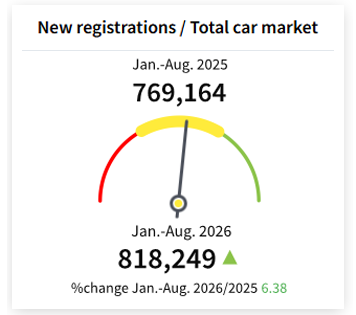
The Spanish car market continued on a positive course over the first eight months of 2026. At 818,249 new registrations, volume stands 6.38 % above the same period of the previous year. Growth was therefore moderate but stable.
Powertrains: hybrids gain, combustion gives way
All-electric cars still account for a modest 10.17 % of the total market. Even so, their share continues to rise year on year. With 83,190 new registrations between January and August 2026, the segment has already reached around three quarters of the full-year volume for 2025 (101,842 units).
Hybrid cars keep gaining market share and now form the largest segment in Spain by volume. With 485,158 new registrations in the first eight months of 2026, more than half of all new registrations fall to this powertrain type. The historical data again shows steady growth: since 2021, annual volume has more than doubled, from 253,858 to 610,588 units in 2025.
Meanwhile, new registrations of pure internal combustion engine (ICE) cars are in steady decline. Diesel in particular is gradually disappearing from the market. The market shares of recent years make the shift plain: what combustion gives up passes mainly to hybrids and, to a smaller extent, to all-electric cars.
Even so, pure ICE cars retain a considerable market share. Of the 818,249 new passenger car registrations between January and August 2026, almost a third went to combustion cars (249,901 new registrations). Measured against 582,317 units in 2021, however, the segment has shrunk markedly.
| wdt_ID | wdt_created_by | wdt_created_at | wdt_last_edited_by | wdt_last_edited_at | ICE energy type | New car registrations Jan. - Aug. 2026 | Car market share Jan. - Aug. 2026 |
|---|---|---|---|---|---|---|---|
| 61 | jBecker | 19.12.2025 12:00 | jBecker | 19.12.2025 12:00 | Total market | 818,249 | 100.00 |
| 62 | jBecker | 19.12.2025 12:00 | jBecker | 19.12.2025 12:00 | Petrol | 188,249 | 23.01 |
| 63 | jBecker | 19.12.2025 12:00 | jBecker | 19.12.2025 12:00 | Diesel | 28,671 | 3.50 |
| 81 | LPG | 27,791 | 3.40 | ||||
| 85 | Other | 5,190 | 0.63 |
Brands and regions: who carries the growth?
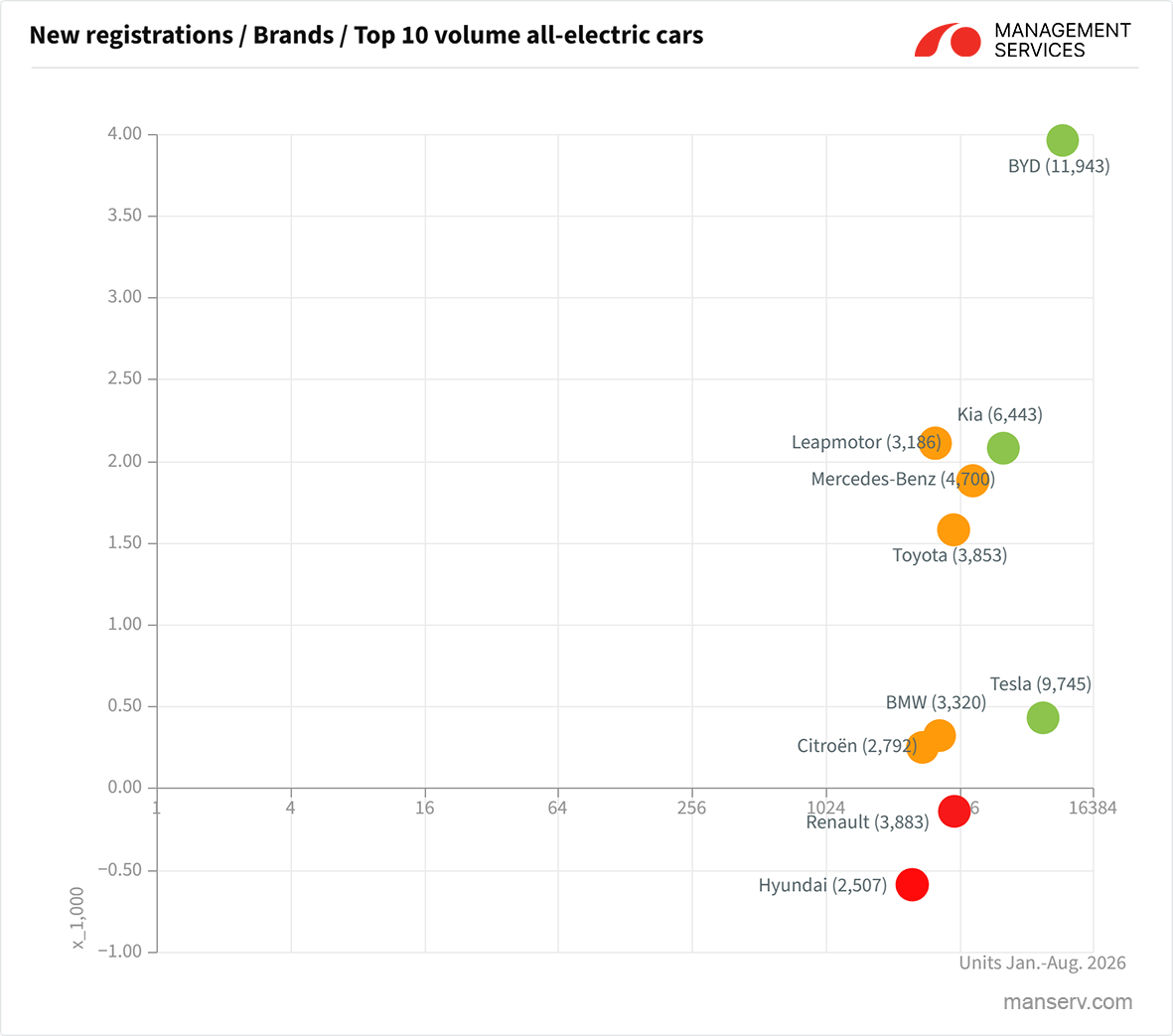
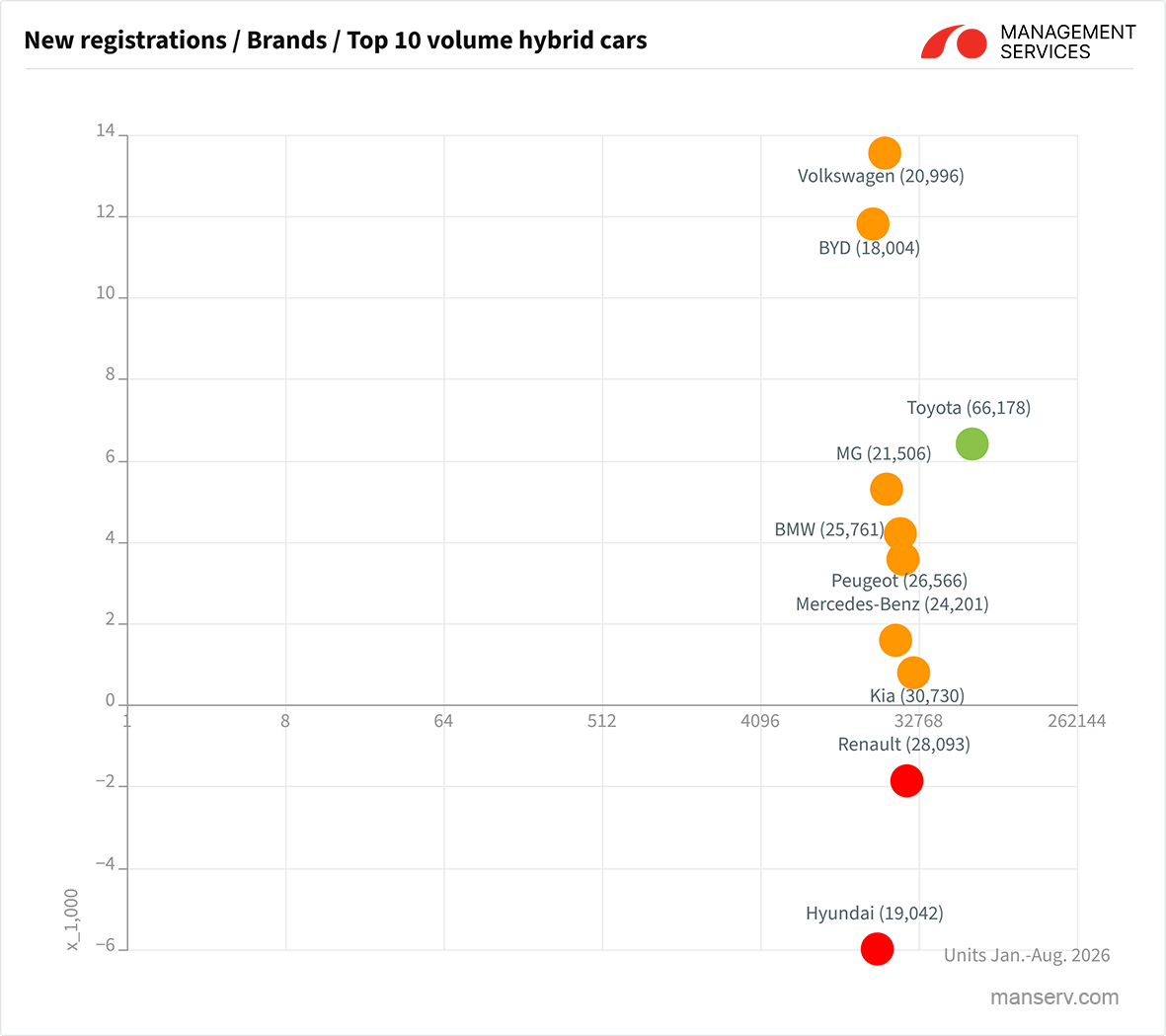
The ranking of car brands in Spain looks very different from one growth segment to the other. The two portfolio charts below make that visible. They show which brands took the ten strongest positions in the all-electric and the hybrid segment between January and August 2026. Each brand is positioned based on two values: the horizontal axis stands for the number of new registrations, the vertical axis for the change against the same period last year. The colouring combines both values.
In the all-electric segment, BYD leads with 11,943 new registrations, followed by Tesla with 9,745 and Kia with 6,443 units. When compared with the same period last year, what stands out is how far apart the brands sit on the vertical axis: BYD gained nearly 4,000 units, whileTesla barely moved, despite having a comparable volume.
The hybrid segment is led by Toyota with 66,178 new registrations, ahead of Kia with 30,730. Eight further brands are staggered behind them, between 18,000 and 29,000 units. The strongest gains come from brands with comparatively small volume.
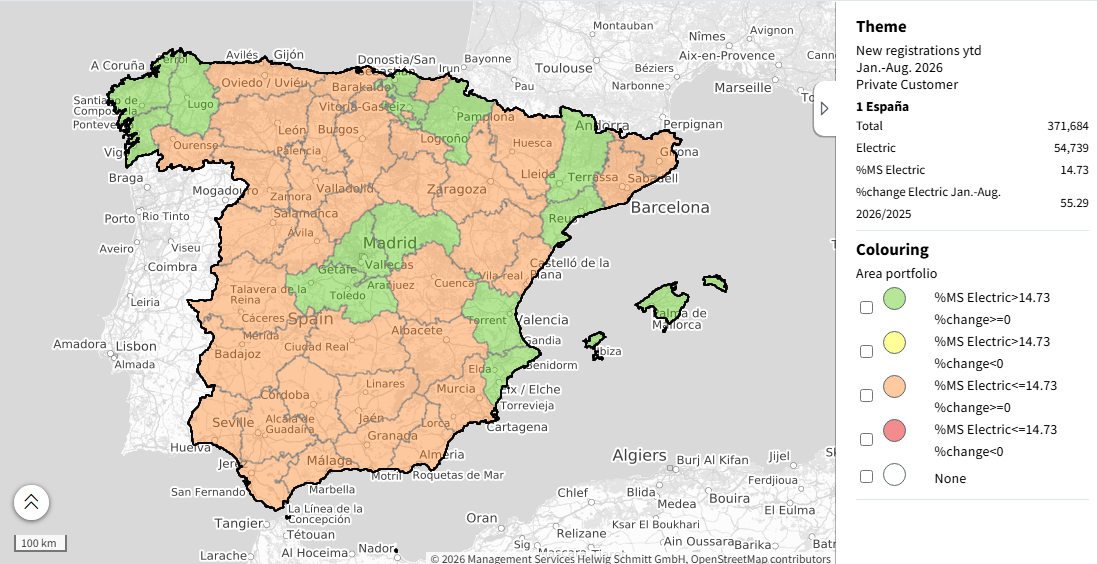
Seen regionally, growth is broadly based: right across Spain, more electric cars reach the road than a year ago. The thematic map below shows for each province whether the all-electric share lies above or below the national average of 14.73 %, and how it has developed year on year. The figures are de-distorted to remove the effect of commercial vehicle registrations. Of the 371,684 car registrations by private customers between January and August 2026, 54,739 were all-electric, an increase of 55.29 %. The provinces coloured green are the main drivers of this growth.
The market grows, electrification keeps the handbrake on
Growth in the Spanish passenger car market in the first eight months of 2026 comes almost entirely from the hybrid segment. All-electric cars grow markedly, yet their share remains just below the 10 % mark. Combustion keeps losing volume but, at roughly a third of the market, remains a fixture.
Electrification in Spain is therefore not arriving as an abrupt technological shift, but rather as a phased transition with hybrids serving as a key intermediate step. The regional map adds a spatial dimension to that picture: the direction is the same across the country, the pace is not.

Luis Miguel Márquez Reyes
Account Manager, Market Analysis Sales International
Luis has worked in account management at Management Services since 2016, where he looks after our international Spanish-speaking markets.
Last updated September 2026
Data source: MSI – Sistemas de Inteligencia de Mercado. New registrations. Retrieved September 07. Own calculation/own layout.
Looking for up-to-date market data on demand?
If you have found these market insights useful, our MIS reporting system is the perfect fit. Featuring monthly processed data and extensive analysis options, it helps you assess global markets at every level – accurately, efficiently, and always up-to-date.